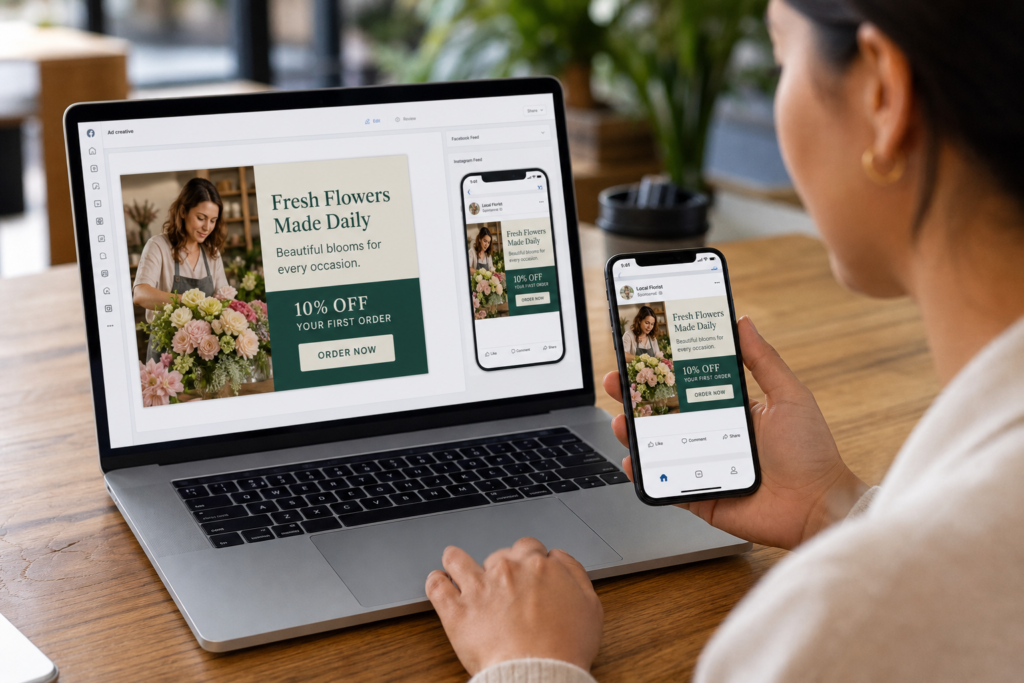
Effective Meta ad creative is not simply an attractive image or short video. For a local business, it should quickly make four things clear: who the ad is for, what is being offered, why it matters, and what the viewer should do next. The best format depends on the campaign goal and message, not on a universal rule that video, carousels, or static images always perform better.
Start with one useful action, such as making an enquiry, booking an appointment, requesting a quote, or visiting a relevant page. Then build the creative, destination, tracking, and follow-up process around that action.
Start with the campaign goal before choosing the creative
A creative brief becomes clearer when it starts with the desired customer action. An advert promoting a limited-time offer may need a prominent benefit and deadline, while an advert for a professional service may need more space for trust, qualifications, or an explanation of the next step.
Write a short brief covering:
- Audience: Who is most likely to need this product or service?
- Problem: What situation or need does the advert address?
- Offer: What is available, and what is the primary benefit?
- Proof: What genuine evidence supports the message?
- Action: Should the viewer enquire, book, call, request information, or visit?
- Destination: Where will the viewer go after clicking?
- Success signal: What counts as a useful result?
This prevents a common mistake: designing a polished advert before deciding what it is supposed to achieve. Awareness, enquiry generation, booking promotion, remarketing, and seasonal sales can all require different messages and creative choices.
Choose the Meta ad format that fits the message

There is no single best format for every local campaign. Choose the format that communicates the offer clearly with a reasonable amount of production effort.
| Format or concept | Useful when | Key tradeoff |
|---|---|---|
| Static image | The offer is simple, visual, and easy to understand at a glance. | Efficient to produce, but it has less room to demonstrate a process or tell a longer story. |
| Short video | The customer benefits from seeing a demonstration, atmosphere, transformation, or person. | Can communicate naturally, but the opening seconds and first frame must work quickly. |
| Carousel | You need to show several benefits, products, steps, services, or customer questions. | Offers more information, but each card needs a clear relationship to the overall message. |
| Testimonial-led creative | Trust and reassurance are central to the decision. | Evidence must be genuine, relevant, and accurate, not presented as a guaranteed outcome. |
| Offer-led creative | You are promoting a defined promotion, event, package, or seasonal opportunity. | Terms, availability, timing, and the next step must be clear. |
A service demonstration may suit video, while a straightforward local promotion may be clearer as a static image. A series of related services may work well as a carousel. Select the format that reduces uncertainty for the customer instead of choosing the format that is most fashionable.
Build a clear message for local customers
Strong Facebook and Instagram ad creative usually has one dominant message. Avoid trying to include every service, qualification, feature, and business benefit in one design. The viewer should identify the main value without studying a dense block of text.
- Hook: Name a relevant need, situation, or benefit.
- Primary benefit: Explain what the customer gets in plain language.
- Local context: Mention the location or service area when it genuinely helps relevance.
- Proof: Add a truthful review, demonstration, process detail, or other support.
- Call to action: Tell the viewer exactly what to do next.
An illustrative example for a local appointment-based business might be: “Need a convenient appointment in Chichester? Check available times and request a booking.” This is only a messaging example, not a claim about a particular business or result.
Keep the visual hierarchy equally simple. Make the benefit or offer prominent, use strong contrast, and reserve secondary details for the caption or destination page. UK advertising must be accurate, truthful, honest, and socially responsible, as set out in the UK advertising rules.
Design for mobile placements and fast scanning
People may encounter your advert while scrolling quickly, so design for immediate comprehension rather than careful reading.
- Put the main offer or benefit in a prominent position.
- Use type size and contrast that remain readable on a small screen.
- Keep important wording away from interface elements and placement overlays.
- Use consistent branding without allowing the logo to dominate.
- Make sure the opening video frame communicates something useful before audio or extended viewing matters.
- Check the creative in the placements you intend to use instead of assuming one crop works everywhere.
- Make the call to action consistent with the destination page.
Mobile-first does not mean removing all detail. It means presenting the most important detail first, then allowing the caption, landing page, form, or conversation to provide context.
Connect creative to the landing page and enquiry journey
An advert can attract attention and still produce poor commercial results if the next step is confusing. The destination should repeat the core promise, explain what happens next, and make the intended action easy to complete.
- Does the destination use the same offer and terminology as the advert?
- Can visitors understand the service, location, relevant terms, and next step?
- Is the form short enough for the information you need?
- Are calls, messages, bookings, and form submissions recorded consistently?
- Who responds to a new enquiry, and how quickly?
Good campaign creative should work with targeted campaigns, persuasive landing pages, and conversion journeys rather than operating in isolation. A compelling image cannot repair a broken booking flow, unclear form, or unanswered enquiry.
Create meaningful creative variations instead of random changes
Testing is more useful when each variation represents a clear question. Keep the core audience and offer reasonably consistent, then change one meaningful element so you can interpret the result.
- Hook: Compare a problem-led opening with a benefit-led opening.
- Visual: Compare a product or service image with a person, process, or environment.
- Proof: Compare a review, demonstration, credential, or process explanation.
- Format: Compare a static image with a short video or carousel.
- Call to action: Compare actions such as “Request a quote” and “Book an appointment” when each accurately reflects the destination.
Record the hypothesis, creative version, destination, audience context, spend context, and outcome. Avoid changing the image, audience, offer, landing page, and call to action simultaneously. If everything changes, you may see a different result without learning which decision caused it.
Meta ad creative pre-launch checklist
| Check | Question to answer |
|---|---|
| Message | Can someone understand the offer and primary benefit quickly? |
| Audience | Does the wording reflect a real need for the intended local customer? |
| Format | Does the format help communicate the message? |
| Readability | Are text, contrast, branding, and the first frame clear on mobile? |
| Destination | Does the page, form, booking flow, or phone journey match the advert? |
| Tracking | Can you distinguish enquiries, bookings, and qualified responses? |
| Follow-up | Is someone ready to handle the response? |
| Truthfulness | Are claims, prices, availability, testimonials, and terms accurate? |
| Disclosure | Is promotional social content clearly identifiable as advertising where required? |
UK guidance says promotional social content should be clearly labelled as advertising when it results from marketing activity or is published on a brand’s behalf. Review the official guidance on social media endorsements, especially when creators, incentives, reviews, or partnerships are involved.
Measure the creative alongside the customer journey
Clicks and impressions can show attention, but they do not prove that a campaign is useful. Review destination-page engagement, completed forms, calls, bookings, qualified responses, and cost per lead where it can be measured reliably.
A high level of attention with few page visits may indicate a weak call to action or technical issue. Page visits without enquiries may point to poor message match, an unclear offer, or a difficult form. Enquiries without qualified opportunities may indicate that the creative is attracting the wrong audience or setting the wrong expectation.
Before increasing paid amplification, make sure your creative is tied to a measurable outcome such as enquiries, bookings, or cost per lead. Compare variations against your own campaign goal and customer journey rather than relying on a universal benchmark.
When a local business needs help producing ad creative
Some owners know which offer they want to promote but do not have time to turn it into coordinated copy, visuals, targeting notes, tracking instructions, and follow-up actions. The Biz Heroes creates advertising assets for Meta and Google Display, including copy, creative, targeting, tracking, and measurement guidance.
The platform is designed for local businesses and can use information from a Google Business Profile, services, customers, competitors, local market, and current marketing presence to shape business-specific materials. The output still needs human review before publishing, particularly for claims, availability, terms, brand accuracy, and local relevance.
Frequently asked questions
Should a local business start with image or video Meta ad creative?
Start with the format that explains the offer most clearly and that you can produce accurately and consistently. Use an image for a focused message, and consider video when a process, atmosphere, demonstration, or person adds useful understanding.
How much text should a local business include in Meta ad creative?
Include enough to communicate the main benefit and action, but do not make viewers read a paragraph before understanding the offer. Put secondary detail in the caption or destination page.
What should a local business test first in its ad creative?
Test the element connected to your uncertainty. If customers may not understand the offer, test hooks or benefits. If trust is the issue, test credible proof. If the message is clear but the action is weak, test the call to action or destination experience.
How can a business make promotional Meta content clear and truthful in the UK?
State the offer, important terms, availability, and next step accurately. Do not imply guaranteed results or use testimonials misleadingly. When promotional content is published on a brand’s behalf or involves an incentivised endorsement, make its advertising nature clear.
Conclusion
The most useful Meta ad creative starts with a defined customer action, not a template or trend. Choose the format that makes your offer easiest to understand, build one clear message, design for mobile scanning, and make the destination page and enquiry process a natural continuation of the advert.
Then test purposeful variations and judge them against meaningful signals such as qualified enquiries, bookings, and cost per lead. Investigate the page, form, tracking, and follow-up before deciding that an advert has succeeded or failed.
For business-specific Meta and Google Display ad assets, including copy, creative, targeting, tracking, and measurement guidance, visit The Biz Heroes.

Join the discussion