
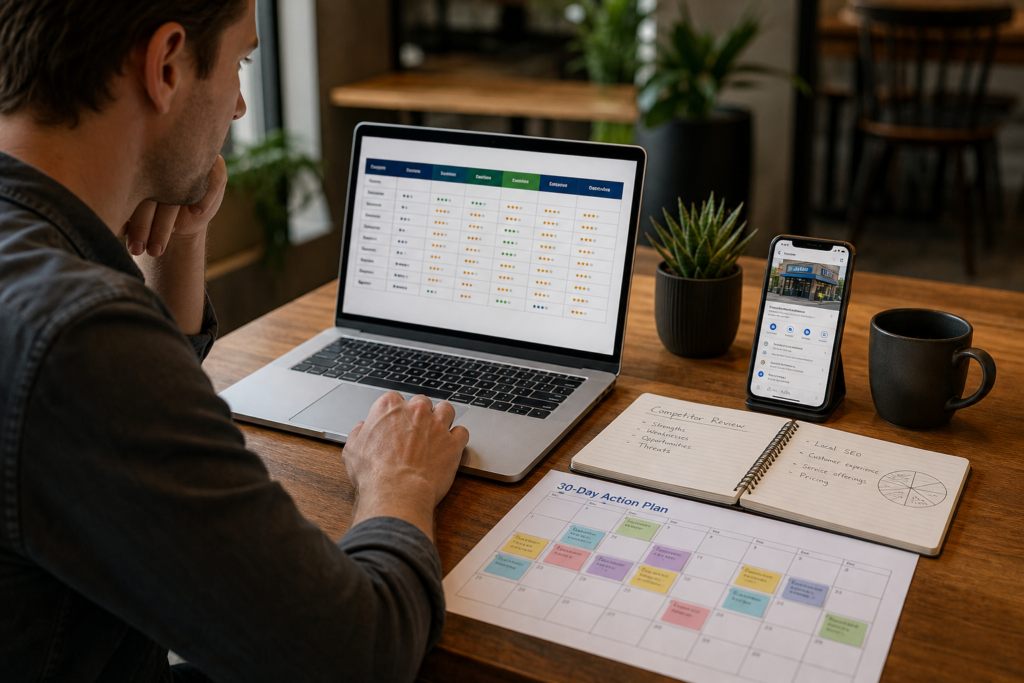
A useful competitor analysis framework should help you decide what to improve, test, differentiate, or stop doing. It is not a long list of competitor facts. For a local business, the best process connects public evidence about services, pricing signals, reviews, local visibility, and customer experience to a specific marketing decision.
That distinction matters because a competitor’s visible activity does not prove its market share, customer preferences, or internal strategy. UK government guidance recommends examining factors such as pricing, target audiences, positioning, and market share, but these should be treated as research inputs rather than conclusions drawn from one public signal. UK competitor analysis guidance provides useful context for this approach.
What a competitor analysis framework should help you decide
Competitor analysis, competitive analysis, and competitor research are closely related terms. In practice, they describe a structured attempt to understand the alternatives available to customers and how your business appears beside them. Marketing intelligence is the broader use of that information to support decisions.
For a local business, the relevant alternatives usually fall into four groups:
- Direct local competitors: businesses offering a similar service to a similar audience in the same area.
- Search-visible competitors: businesses appearing when customers search for the service, even if they are not your closest physical rivals.
- Specialist providers: businesses that compete strongly for one service, customer type, or problem.
- Need-based alternatives: different businesses that may solve the same customer need in another way.
The purpose is not to copy the most visible business. It is to identify what customers can currently understand, compare, and trust, then decide where your business can make a clearer or more useful offer.
The seven-step competitor analysis framework

Use the following process as a repeatable competitor matrix workflow. Each step should produce a practical output, not just more information.
1. Define the decision before collecting data
Start by writing the question your research must answer. “What are competitors doing?” is too broad. Better questions include:
- Which local service should we explain more clearly?
- Why might searchers choose another business before contacting us?
- Which trust signals should we improve this month?
- Do we need stronger local search visibility, a clearer offer, or better follow-up?
- Is there a seasonal campaign opportunity that fits our audience?
Record the decision, location, timeframe, and intended measure. For example, you might review five businesses serving a defined area, identify the most important visibility and conversion gaps, and choose three actions to complete within 30 days. This prevents interesting but irrelevant observations from taking over the project.
2. Choose up to five competitors that represent real alternatives
A small, relevant sample is usually more useful than a directory of names. Select no more than five businesses that overlap with your service, audience, geography, or customer problem. Include a mixture where appropriate: two direct local competitors, one highly visible search competitor, one specialist, and one business that appears to win on a particular customer need.
Check that each business is genuinely comparable. A national provider may appear in search results but offer a different customer experience from a local business. Likewise, a premium specialist may be useful for studying positioning without being a realistic pricing comparison.
The Biz Heroes states that its competitor analysis service can compare up to five competitors using publicly available evidence and produce a practical local response plan. That sample size is also a sensible limit for manual research because it keeps the comparison detailed enough to review consistently.
3. Collect public evidence consistently
Use the same research categories and the same observation method for every competitor. Save the page or profile location, date, and exact wording where it matters. Do not rely on memory or a general impression such as “their marketing looks better.”
Useful evidence categories include:
- Google Business Profile: business category, services, description, location information, photos, updates, review responses, and visible calls to action.
- Services and positioning: what is offered, who it appears to serve, and which benefits are emphasized.
- Website clarity: whether visitors can quickly understand the offer, service area, next step, and reasons to trust the business.
- Reviews and reputation: recurring customer themes, response behavior, and the types of experience customers mention.
- Content activity: recent posts, educational material, seasonal messages, social activity, and signs of consistency.
- Offers and pricing signals: published prices, packages, promotions, guarantees, minimum commitments, or language that indicates a market position.
- Trust signals: qualifications, case evidence, policies, testimonials, business details, and clear contact information.
When reviewing your own profile, a focused Google Business Profile optimization process can help separate basic accuracy issues from higher-value improvements. For local search research, use a consistent set of search terms and locations rather than selecting whichever results confirm your first impression.
4. Build a local competitor comparison matrix
A matrix makes differences visible and reduces the temptation to judge businesses by design quality alone. Use one row per competitor and record the evidence in columns such as these:
| Category | What to record | Decision it may support |
|---|---|---|
| GBP completeness | Services, description, photos, updates, contact details, and local signals | Which profile improvements should be prioritized? |
| Service clarity | Named services, customer problem, audience, and benefit | What should we explain more clearly? |
| Reviews | Common themes, response style, and visible trust patterns | Which customer concerns should our content address? |
| Website conversion | Calls to action, enquiry route, proof, and service-area clarity | Where might a visitor hesitate? |
| Content activity | Recent topics, frequency, usefulness, and seasonal relevance | Which questions or occasions are under-served? |
| Offers and pricing signals | Published prices, packages, promotions, or positioning language | How can we frame value without guessing? |
| Trust signals | Credentials, policies, testimonials, examples, and contact details | What could reduce customer uncertainty? |
Add three further columns to every observation: evidence source, confidence, and proposed action. You can also add an implication column, but keep it separate from the observation. A practical local keyword research process can support the search-term portion of this work by connecting customer language to marketing actions, rather than treating keywords as a ranking checklist.
5. Separate observations, interpretations, and assumptions
This is the step that keeps competitor research honest. Use three layers:
- Observed fact: “The business website displays a service package with a published starting price.”
- Reasonable interpretation: “The business is making price comparison easier for some visitors.”
- Unverified hypothesis: “Customers choose this business because it is cheaper.”
Assign each finding a confidence level. Use high when the information is directly visible and current, medium when the signal is clear but incomplete, and low when the conclusion depends mainly on inference.
A missing offer does not prove that a competitor does not provide it. A high visible review count does not prove market leadership. A business ranking for one search does not prove it ranks consistently across locations, devices, or search terms. Keep those distinctions in the matrix so hypotheses can be tested rather than published as facts.
6. Identify gaps and defensible local positioning
Look for opportunities that improve the customer’s decision, not weaknesses you can exaggerate. Potential gaps include an unclear service explanation, no obvious next step, limited local relevance, unanswered customer questions, inconsistent review responses, weak trust evidence, or content that does not address a recurring need.
Then prioritize each opportunity against five criteria:
- Customer value
- Strength of the evidence
- Effort required
- Speed of testing
- Fit with your actual capability and offer
For example, if several competitors describe a service in technical language but none clearly explain the customer outcome, a plain-language service page or Google update may be a sensible test. If business information is inconsistent across listings, accuracy should come before a larger content campaign. Local SEO citation work can be useful when it addresses a verified information or visibility problem, not simply because more listings sound beneficial.
7. Turn findings into a 30-day response plan
Do not attempt to respond to every finding. Select two or three priorities and assign an owner, completion date, evidence of completion, and review measure.
| Timeframe | Focus | Possible actions |
|---|---|---|
| Days 1 to 7 | Baseline and accuracy | Confirm services, contact details, location signals, website paths, and priority customer questions. |
| Days 8 to 14 | Visibility and trust | Improve the Google Business Profile, prepare review requests, clarify a service page, or strengthen trust information. |
| Days 15 to 21 | Supporting communication | Publish useful local content, prepare social posts, send an appropriate email, or develop a focused seasonal message. |
| Days 22 to 30 | Review and decide | Check completed actions, customer responses, enquiries, profile activity, and operational feedback before choosing the next test. |
The Biz Heroes describes its AI-assisted marketing workflows as a way to turn business and competitor context into materials such as local SEO plans, marketing audits, content, campaigns, and growth plans. Whether you work manually or use a workflow, the response plan should remain tied to the original decision and should not promise rankings, leads, or revenue.
Manual research or AI-assisted competitor analysis?
Manual research gives you direct control and may be enough when you have only a few competitors and a narrow question. Its main weakness is inconsistency: research can be delayed, notes can be incomplete, and comparisons can become subjective.
AI-assisted research can organize public evidence, compare repeated categories, identify possible patterns, draft a matrix, and prepare a response plan faster. It is most useful for preparation and prioritization, not for removing judgment. A more automated process may save time, but it also increases the importance of permissions, monitoring, and approval controls.
Keep a person responsible for checking business names, services, prices, offers, competitor references, customer-facing claims, and policy-sensitive content. UK guidance on AI agents recommends accurate marketing information and regular review of AI-generated campaigns by someone with appropriate experience. The Biz Heroes similarly advises human verification of factual and customer-facing outputs before publication.
Ethical and compliant competitor research checklist
- Use publicly available information and record where and when you found it.
- Compare like with like. Do not present different services or packages as equivalent.
- Do not invent prices, customer motivations, weaknesses, results, or market share.
- Describe an uncertain finding as an observation or hypothesis, not as a proven competitor failure.
- Check claims, offers, prices, and dates before using them in marketing.
- Do not use a competitor’s logo or trademark improperly in a comparison.
- Ask whether your comparison would be clear and fair to an ordinary customer.
- Have an experienced person review AI-generated comparisons and published campaigns.
UK advertising guidance says comparisons must be accurate and not misleading, and should concern equivalent products or services. It also warns against improper use of competitor logos or trademarks. Review the relevant UK advertising comparison guidance when a campaign names or directly compares another business.
A compact competitor analysis checklist
- Write the decision, location, timeframe, and intended measure.
- Select up to five competitors that represent real customer alternatives.
- Capture dated public evidence across the same comparison categories.
- Record observations separately from interpretations and assumptions.
- Assign a confidence level to each meaningful finding.
- Identify gaps that could improve visibility, trust, clarity, or conversion.
- Prioritize actions by customer value, evidence, effort, speed, and fit.
- Assign owners and dates in a 30-day response plan.
- Review the evidence and outcomes before repeating or expanding the work.
Frequently asked questions
How many competitors should a small local business analyze?
Start with three to five relevant competitors. Up to five is usually enough to identify recurring patterns while keeping the evidence detailed and comparable. Add another business only when it represents a materially different customer alternative.
What should be included in a local competitor analysis matrix?
Include services, positioning, local signals, Google Business Profile information, reviews, website clarity, calls to action, content activity, offers, pricing signals, and trust evidence. Add the source, date, confidence, implication, and proposed action so the matrix leads to decisions.
Can competitor analysis reveal what a competitor charges?
It can reveal published prices, packages, promotions, or language that signals a market position. It cannot reliably reveal private discounts, negotiated prices, costs, or total market pricing. Treat visible pricing as one evidence point and avoid claiming that it explains customer choice.
How can I identify a competitor gap without making unsupported assumptions?
Describe exactly what is visible, state what it might mean, and label the conclusion as a hypothesis when it is not verified. Then test your response through a clearer offer, useful content, improved trust information, or a focused customer communication.
Can AI conduct competitor research for a local business?
AI can help organize public evidence, apply consistent categories, identify patterns, and draft a response plan. It should not replace human checks of facts, prices, offers, comparisons, customer claims, or compliance-sensitive content.
How often should a local business repeat competitor analysis?
Review the response plan after 30 days, then repeat a broader comparison quarterly or when your market, services, location, or competitors change significantly. Shorter checks can monitor specific categories without rebuilding the entire analysis.
Conclusion: use competitor research to choose your next move
A strong competitor analysis framework is a decision system. Define the question, compare a small and relevant group, collect public evidence consistently, separate facts from interpretation, and choose only the opportunities that fit your customers and capabilities.
Start with a matrix you can actually maintain, then turn the findings into a 30-day plan covering a few practical improvements to local visibility, trust, clarity, or follow-up. AI-assisted research can make that process faster, but the final responsibility for accuracy, fair comparisons, and published marketing remains with a human reviewer.
For a workflow that compares up to five competitors using public evidence and produces a practical local response plan, explore The Biz Heroes.

Join the discussion